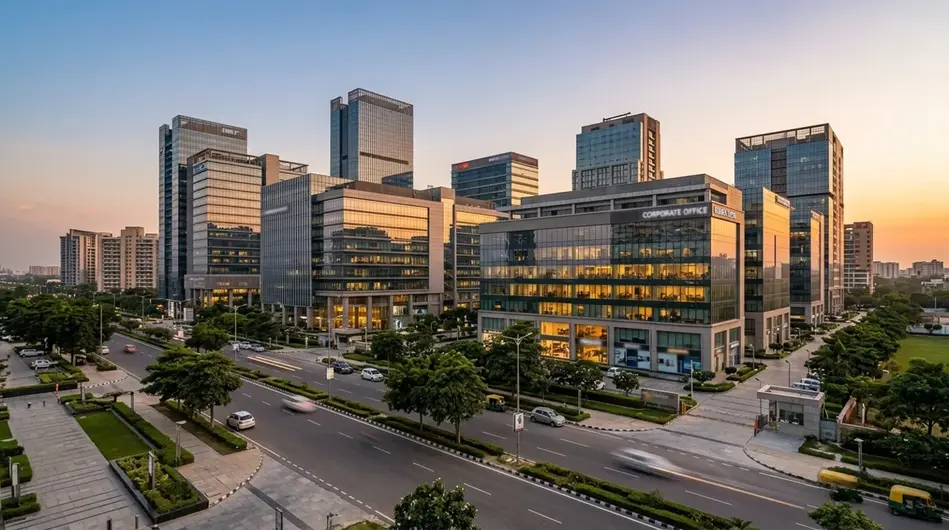
Why Commercial Property Investment in Gurgaon Is Gaining Attention
Commercial property investment in Gurgaon has moved from a niche interest among seasoned investors to a mainstream consideration for a much wider range of buyers. Part of this comes down to simple arithmetic: Gurgaon hosts one of North India's densest concentrations of corporate offices, from established business districts like Cyber City and Udyog Vihar to newer commercial corridors spreading along Golf Course Extension Road, Sohna Road and the Dwarka Expressway.
That corporate density translates directly into demand for office space, retail frontage and the everyday commercial infrastructure — restaurants, service outlets, clinics, salons — that a working population needs close to where it spends its day.
Infrastructure has played an equal role. Expressway connectivity, metro expansion and the steady development of new sectors have opened up commercial corridors that simply didn't exist a decade ago. For an investor, this combination — consistent business activity plus expanding infrastructure — supports sustained demand for commercial real estate over time, rather than demand tied to a single industry or a single pocket of the city.
This is also why commercial real estate investment in Gurgaon increasingly shows up in portfolio-diversification conversations. For an investor otherwise concentrated in equities, mutual funds or residential property, a well-chosen commercial asset offers a different risk-and-return profile — often built around rental income rather than price movement alone.
That said, commercial property investment opportunities in Gurgaon vary enormously in quality and suitability, and being located in a growing city guarantees nothing about how any specific asset will perform.
How Commercial Property Can Generate Investment Returns
Commercial property investment generally works through two distinct components, and it's worth understanding them separately rather than as one blended “return.”
The first is rental income. A leased commercial asset — whether a retail shop, an office floor or a commercial unit of some other kind — can generate recurring income for as long as it remains occupied by a paying tenant.
But rental performance is not automatic or uniform: it depends heavily on tenant demand in that specific micro-market, the occupancy history of the asset, the quality and stability of the tenant itself, the terms of the lease (duration, escalation clauses, renewal conditions), the property's location and type, and the ongoing operating and maintenance costs that eat into gross rental income before it becomes net return.
Two commercial units in the same building can generate meaningfully different rental income depending on these factors.
The second component is capital appreciation — the possibility that the asset's value increases over the holding period, influenced by continued infrastructure development nearby, the pace of business expansion, the balance of demand and supply for similar assets, and the underlying quality of the asset itself.
None of this is guaranteed: appreciation is not an assured outcome, and past performance in a given corridor doesn't reliably predict future results for a specific asset.
So, how much return can I expect from commercial property in Gurgaon? There's no honest single-number answer.
Realistic returns depend on the interaction of all the variables above — location, tenant quality, lease structure, entry price, holding period and ongoing costs — and any source offering a fixed percentage without qualifying these variables should be treated with scepticism rather than taken as a reliable projection.
Which Commercial Property Is Suitable for Investment in Gurgaon?
There is no single commercial property type that is universally best for every investor in Gurgaon — the right fit depends on your budget, risk tolerance, and what you're actually trying to achieve with the investment.
Retail shops and high-street retail typically offer the lowest entry cost and can draw on steady footfall in established, walkable stretches, but depend heavily on that location's foot traffic and tenant category.
Office spaces and commercial floors require a larger entry ticket but can offer longer lease terms and more stable tenant profiles, particularly in established business districts. Other formats — service-sector units, mixed-use commercial spaces — sit between these two, and their suitability depends on the specific project and corridor.
Rather than asking which type is best in the abstract, it helps to compare options against a consistent set of practical criteria: entry cost relative to your budget, realistic rental demand in that specific location, the likely tenant profile and its stability, vacancy risk if a tenant leaves, how easily the asset could be resold or exited if your circumstances change, ongoing maintenance requirements, the strength of the specific location, your intended holding period, and your own tolerance for the ups and downs that come with any real estate investment.
Which type of commercial property is best for investment in Gurgaon, then, is really a conditional question — the answer depends on which of these factors matter most to you, not on a generic ranking of asset types.
If you want to see the specific commercial projects currently available across Gurgaon's major corridors, our M3M Commercial Projects in Gurgaon page covers current inventory, location and configuration — this article focuses on the investment logic rather than individual listings.
What to Check Before Investing in Commercial Property in Gurgaon
Before committing to any commercial property investment in Gurgaon, a practical due-diligence process is worth more than any amount of market enthusiasm. At minimum, work through the following:
Start with location and micro-market fundamentals — what's actually driving demand in that specific corridor, and is that driver likely to persist? Check the developer's track record on delivery timelines and build quality, since a commercial asset is only as good as the building it sits in.
Confirm RERA registration where applicable, and independently verify title and legal documentation rather than relying solely on a broker's assurance. Understand the exact unit configuration and usable area you're buying, since commercial carpet, built-up and super area divs can differ meaningfully from what's advertised.
On the income side, assess existing or realistically expected rental demand for that specific unit type and location, the likely tenant and occupancy profile, and the lease structure you'd be working with — including how rent escalation and renewal terms are handled.
Factor in maintenance and operating costs, since these reduce net return regardless of how strong gross rental income looks on paper. On the financial side, be clear-eyed about your entry price relative to comparable assets, your exit and liquidity potential if you need to sell before your ideal holding period, any financing requirements and the interest cost attached to them, and the full set of applicable taxes and transaction costs — stamp duty, registration, GST where relevant — that add to your real acquisition cost beyond the quoted price.
How to invest in commercial property in Gurgaon, practically speaking, follows this sequence: identify an asset type and location that match your risk tolerance and budget, evaluate its realistic income and appreciation potential using the variables above rather than a developer's projections alone, complete legal and title verification, and only then proceed to purchase.
Commercial property can genuinely form part of a sound, long-term investment strategy — but that outcome depends on assessing the individual asset, its location, realistic tenant demand, your entry price and the complete cost structure around it, rather than assuming that any commercial property in a growing city like Gurgaon will perform similarly to another.