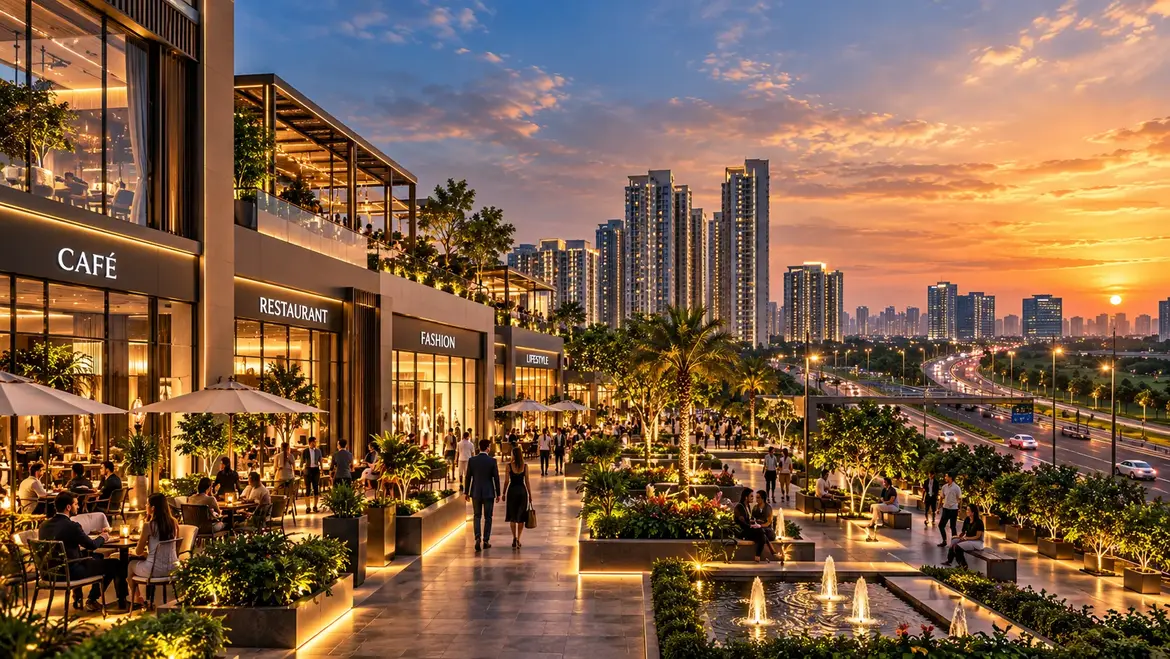
Why Sector 113 Is Emerging as a Commercial Hub on Dwarka Expressway
Sector 113 in Gurugram is increasingly discussed as an emerging commercial micro-market. Its position on Dwarka Expressway links it toward Delhi and the wider Delhi-NCR region, while a growing residential catchment is building everyday demand for retail, food and services. This article looks at the broader forces behind that shift and where developments such as M3M Capital Walk Commercial fit in. Project specifications are covered on the dedicated project page.
Why Sector 113 Is Attracting Commercial Interest
Sector 113 sits along Dwarka Expressway, a corridor designed to ease travel between Delhi, Gurugram and the airport belt. Proximity to Delhi and IGI Airport widens the pool of customers, staff and business visitors who can reach the area without relying only on older routes.
Residential development around the sector is adding households, and with them a steady need for shopping, dining, banking and services. As infrastructure matures, businesses tend to follow population, which is why commercial real estate in Sector 113 and neighbouring sectors is drawing attention. M3M 113 Commercial is one example of how developers are responding to that shift.
The Rise of High-Street Commercial Spaces in Gurgaon
High-street commercial spaces differ from conventional enclosed malls. Shops and restaurants face an open, walkable frontage instead of sitting inside one building with controlled entry. For many businesses, this means stronger visibility, easier access and a more casual customer experience.
The format suits cafés, restaurants, specialty retail, clinics and service brands that depend on passers-by as much as planned visits. It also creates a retail and F&B cluster where one business can benefit from the footfall of its neighbours.
As Gurgaon's newer sectors mature, high-street commercial property is becoming a familiar alternative to mall retail. M3M Capital Walk Commercial is positioned within this format, though suitability always depends on the unit and the business.
How Residential Growth Can Influence Commercial Demand
A commercial area rarely thrives without people living nearby. Every new residential community adds daily consumption: groceries, meals, salons, pharmacies, fitness, coaching and professional services. Businesses serving these needs depend on a catchment that is large enough, close enough and still growing.
That is why the pace of residential occupancy matters as much as launches or announcements. For anyone assessing commercial property in Sector 113 Gurgaon, the question is not only how many homes are planned, but how many are occupied and how residents travel.
Demand is never guaranteed. Occupancy, competition and consumer habits all shape results.
What Businesses Look for in an Emerging Commercial Area
Different businesses weigh different factors, but most evaluations start with this checklist:
- Accessibility: how easily customers and staff can reach the location
- Visibility: frontage and sightlines from main roads and walkways
- Catchment: the size and spending pattern of nearby residents
- Footfall potential: both existing and likely future traffic
- Surrounding development: what is built, occupied or planned nearby
- Competition: similar businesses within easy reach
- Parking and access: convenience for customers and deliveries
- Business suitability: whether the format fits the intended use
M3M 113 Commercial and the Wider Sector 113 Market
Individual developments matter because they give a micro-market its commercial identity. When shops, restaurants and offices cluster together, they create a destination that residents and visitors learn to associate with a type of activity.
M3M 113 Commercial can be read in that context: not as a standalone event, but as part of a wider process in which retail, F&B and business uses gradually build an ecosystem around Sector 113. The surrounding market matters because a unit's performance depends on neighbouring uses, access and overall footfall.
For project-specific information, see the M3M 113 Capital Walk page.
What to Consider Before Choosing Commercial Property in Sector 113
Look beyond the sector name to the specific unit. Check its location within the development, frontage and visibility, floor, and ease of access for customers and deliveries. Review surrounding occupancy and the mix of nearby businesses.
Understand the applicable costs, which can include taxes, maintenance and fit-out, and match the unit to your intended business use. Finally, assess local demand realistically.
This is not investment advice. No appreciation, income or other outcome is assured, so independent professional advice is sensible.
Future Commercial Potential of Sector 113
Sector 113's commercial story will depend on continued infrastructure delivery, ongoing residential expansion and reliable Delhi-Gurgaon connectivity. If these hold, the retail, F&B and service ecosystem could broaden over time, though timing and pace are uncertain.
Newer developments such as M3M 113 Capital Walk will add to that picture, while the market will ultimately be shaped by occupancy and actual consumer behaviour.
Conclusion
Sector 113 deserves attention as an emerging commercial market because of its Dwarka Expressway position, Delhi-NCR connectivity and growing residential base. High-street formats add visibility and an active retail and F&B environment, but outcomes depend on unit-level factors and demand.